
How to Make Money with Divi
We may earn a commission from affiliate links in this post. Disclosure policy
Divi has one of the largest communities of any WordPress theme, and all those developers and site owners need products, services, training, and help. That demand is what makes Divi a practical starting point for a business rather than just a way to build a website. In this article, we’ll look at the ways to make money with Divi, what your site needs before any of them work, and the skills that hold the whole thing together.
None of these methods are guaranteed, but they have been tried and proven by thousands of Divi users. Your results will vary, so plan well. They’re in no particular order, and most of them can be combined.
What Your Site Needs Before It Earns Anything
I don’t recommend starting a blog if your goal is to make money fast. It takes a while to build what your site needs first, and that list is short but non-negotiable.
Traffic – you don’t necessarily need thousands of visitors per day. You need the right visitors per day. More is better, but a targeted audience matters more than raw numbers.
A content strategy – keep a publishing calendar. Publish several times per week on various topics within your genre. That builds your audience and your authority at the same time.
An email list – most visitors won’t return to your website on their own. An email list is how you tell them about new content and special offers.
The common thread: you need an audience to make money from, and a reason for them to keep coming back. Once you have targeted traffic, a body of content, and a list to market to, the methods below start to work.
Affiliate Marketing
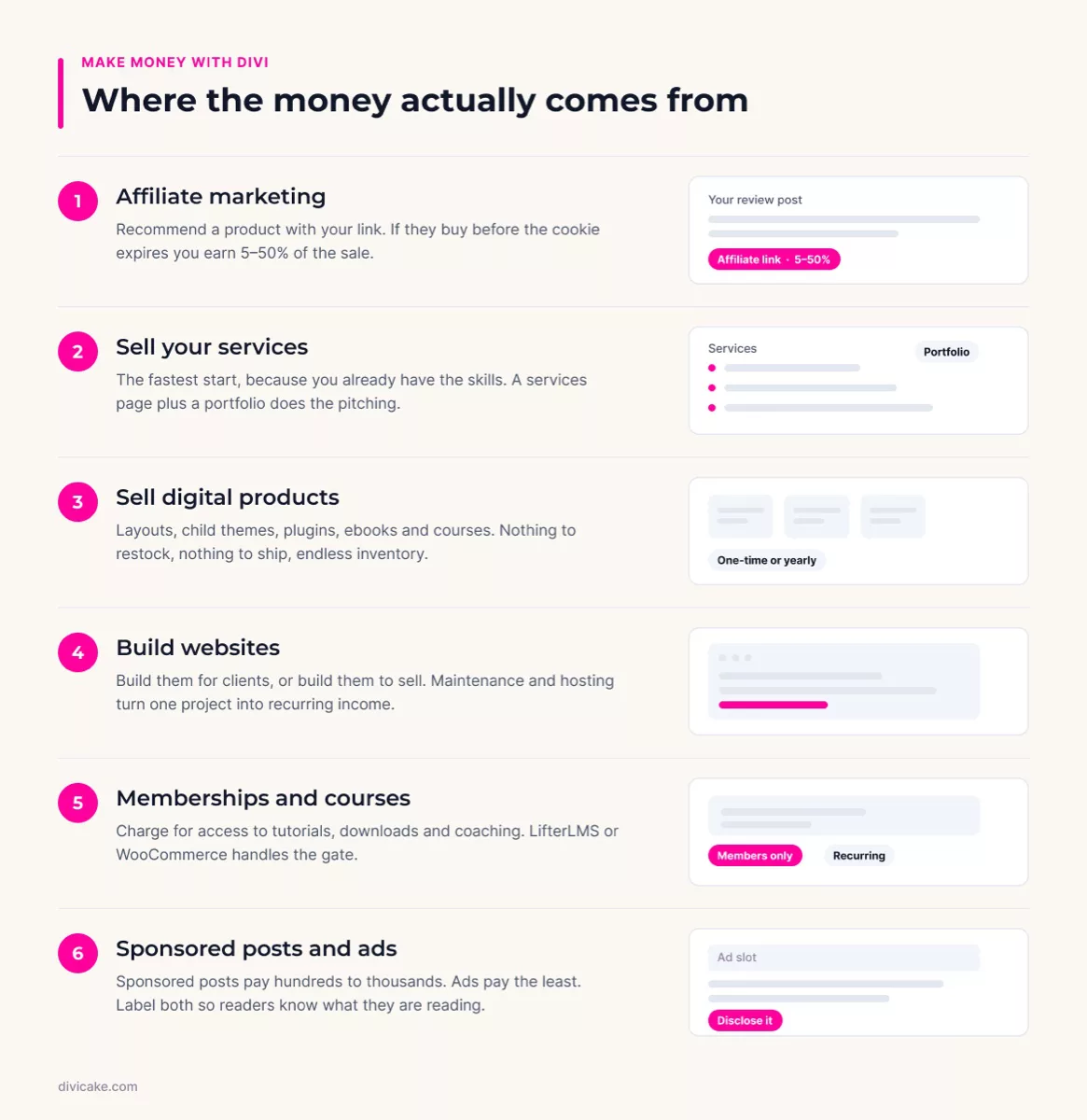
With affiliate marketing, you tell your audience about a product and provide an affiliate link. If they click it and buy before the cookie expires, you get a portion of the sale. Commissions often range from 5–50% depending on the product, so earnings range from a few cents to a serious monthly income. It’s my favorite way to monetize a blog, but it needs traffic and the right products to make significant money.
Types of affiliate programs
Almost any product can have an affiliate program, and they’re handled in a few ways.
Large online stores – stores like Amazon and Walmart sell many types of products from many manufacturers.
Smaller niche stores – shops that focus on fewer topics, like Divi or WordPress, and provide products within those topics.
Affiliate services – networks like Commission Junction and ShareASale run and manage the affiliate programs for many publishers.
Publishers – companies like Elegant Themes sometimes run their own affiliate programs.
You can usually find a program in the footer of a website. For WordPress work, look at Elegant Themes, Divi shops, hosting companies, courses, and design tools. For a longer list, see Best Affiliate Programs for Divi Blogs.
Promoting the products
You can mention products inside your content, build content around them, and place banners in your layouts. That content can be blog posts, podcasts, or videos. The formats that work best are lists of products on a specific topic, detailed tutorials and walkthroughs, honest reviews, and news about releases.
Affiliate links should be disclosed so your audience knows they’re clicking an affiliate link and that you’ll get a portion of the sale. For the legal side of it, see the FTC’s Endorsement Guides.
Sell Your Services
Providing a service is the fastest way to start, because you’re selling skills you already have. That can be coaching, consulting, training, web development, content creation, editing, photography, and plenty more. Many companies need work done remotely but don’t want to hire full-time for it, which is exactly the gap a freelancer fills.
Create a page that describes your services and links to examples, with a separate portfolio page for the detail. Lead with what you want to sell the most. You can work part-time or full-time, and with as many or as few clients as you want. Work isn’t guaranteed, which is the risk, but it also gives you a level of freedom you can’t get any other way.
Sell Digital Products
The Divi user base is large and always looking for new designs and features, which opens up room to build and sell Divi products: layouts, child themes, and plugins. They combine, too — your layouts and plugins can live inside your child themes. There are already a lot of Divi products out there, so the designs and features need to be as good as you can make them to compete. Sell them as digital downloads, either as a one-time purchase or an annual subscription that includes updates and support.
Digital products go well beyond Divi products: ebooks, courses, audio, and video. You can repurpose a lot of your published content into products — just add more detail and examples. Downloads don’t need to be manufactured each time they sell, so you have endless inventory and nothing to ship.
Divi integrates with WordPress eCommerce platforms, so you can sell from any Divi site. Use WooCommerce or Easy Digital Downloads to manage the sales, and the Divi Builder’s WooCommerce modules to design the product pages. Physical products work too — things you make, have produced for you, or dropship — but digital is the easier place to start.
Build Websites — for Clients or for Sale
Lots of companies need new websites, and just as many need old ones rebuilt. The work is to understand the client’s needs, decide which features they actually require, choose the right tools, and build the site. Divi speeds that up considerably: the drag-and-drop builder handles most of the design, and there are child themes, layouts, and plugins for nearly any kind of site. Maintenance, hosting, and training then turn a single project into a recurring income stream.
You can also build websites to sell rather than to hand over. Build one from scratch and a buyer gets a site with no history but everything ready to go; adding an audience, an email list, and content makes it worth considerably more. The alternative is to acquire an established site, improve its design and features, grow the audience, and fix whatever problems it has before putting it back up for sale.
Create Courses
Online courses are a natural fit if you’ve developed a skill worth teaching — WordPress, Divi, programming, WooCommerce, building an email list, running webinars, graphic design, business, writing, art, or music.
Divi works well with course platforms such as LifterLMS, so you can add courses to an existing Divi site or build a course site from the ground up. You can also host courses on Teachable, Udemy, or Skillshare and use your site to send people there.
Run a Membership Area
A membership site charges a recurring fee for content non-members can’t see: detailed tutorials, downloads, webinars, coaching, forums, and private groups. Use plugins such as LifterLMS, or WooCommerce with add-ons, to add a membership area to a Divi site — built around the membership, or bolted onto the site you already have.
The catch is producing enough content that’s genuinely worth paying for. What you can charge depends on your expertise and the quality of what sits behind the paywall — anywhere from a dollar a month to many hundreds of dollars a year.
Sponsored Posts
Sponsored posts are articles you’re paid to write or paid to publish. They look like normal posts and usually focus on another company’s products or services. Depending on your audience, companies will pay from hundreds to thousands of dollars to have their content on your blog. Two rules: only publish articles about products you actually believe in, and label them as sponsored so your audience knows what they’re reading.
Ads
Ads are banners that companies pay to place on your website — in the header, the sidebar, the footer, under the content, or inside it. Divi ships an Adsense widget you can drop into a sidebar; paste your code into it and you’re done.
Most ads are CPC (cost per click) or CPI (cost per impression), and they don’t pay much either way. Add ad-blockers to that and ads probably return the least of anything on this list, though they can still bring in income at high traffic. Native advertising performs best — ads that fit the content and look natural in it, usually inside the content feed or in a block under an article.
Start a YouTube Channel or Podcast
Everything you’d write for a blog works as video or audio too. Review products, cover deals, interview guests. You can offer discount codes through your affiliate links, and companies will sponsor individual videos and episodes once you have an audience worth reaching.
The Skills Behind All of It
You don’t have to be the best designer or programmer in the world, but you do need a working command of a handful of things.
WordPress – pages, posts, menus, backups, the customizer, installing themes and plugins, and the file editor. FTP, local installs, and knowing how to test a site properly all help.
Divi – the Divi Builder, the Theme Builder, Divi options, creating layouts, saving to the library, importing and exporting designs, and where code goes. The fastest way in is to load the Builder and start tinkering; after that, there are plenty of Divi blogs, videos, podcasts, and courses.
Enough code to be dangerous – you don’t have to code to build good sites with Divi, but you do need to take a snippet from a tutorial, adjust it, and know where it belongs. The languages that come up most are HTML, CSS, JavaScript, jQuery, and PHP.
An eye for design – you don’t have to originate every idea, but you need to recognize good design when you see it. Layouts and child themes give you a head start, and browsing design sites and theme shops of any platform is good for inspiration. Take ideas, don’t copy them.
Image editing – know the file types that belong on a website and how to edit them. File conversion is the part people skip: when a client sends a 184MB photo for their homepage, you need to turn it into something a page can actually load.
A toolbox – collect layouts, child themes, plugins, code snippets, graphics, and icons you can start from. Rebuilding the same thing from scratch every time is the slowest way to work.
The Business Side
The skills get the work done. These turn it into a business.
A portfolio and testimonials – highlight the skills you want to use and the work you want more of, and build a couple of example sites if you’re starting from nothing. Ask for a testimonial as soon as a job is complete. Your own website is a better home for all of it than a social profile, and it doubles as an example of your work.
Pricing – prices that are too low read as low quality or suspicious. Prices that are too high get ignored, and the few clients who do sign will expect results to match. Define your services clearly so people know what’s included, and price competitively with room to grow.
Business management – you don’t need an MBA, but you do need the basics: choosing clients, taking projects inside your skill set, and managing money. Do a SWOT analysis, set goals, decide whether you’re specializing, and define your ideal client. Use clear contracts that state the services, what’s included, what the client is responsible for, the cost, the delivery date, and when the bill is due.
Marketing – build your network through LinkedIn, Facebook, WordPress blogs, meetups, and WordCamps. Be present and be helpful: post tips, answer questions, pitch when the time is right. Ask for referrals the moment a project is finished, and upsell existing clients on maintenance or hosting.
Communication and project management – make sure both sides understand the scope, the expectations, the price, and the deadlines, and keep the conversation in writing with something like Asana or Slack. Avoid scope creep, set milestones and track them, and always meet or beat your deadline. If you can’t, tell the client immediately, explain why, and negotiate a new date. If a project needs a skill that isn’t your strength, contract it out.
Knowing when to say no – if the fit, the money, or the schedule is wrong, decline. Take everything and you’ll end up overworked, underpaid, and resenting the business you started. A few clients who pay well beat a lot of clients who pay poorly. Make sure a client is serious before you spend hours on an estimate.
Ending Thoughts
None of these methods are fast. It takes time to create products, build an audience, and get a business off the ground, and affiliate sales can take months before the money arrives. What they have going for them is low overhead: most can be started small, or as a side project alongside other work, and all of them scale — just in different ways.
The best approach is to diversify. Don’t pick one thing off this list and stop there; several of them combine into a much stronger income than any one manages alone. Follow good design and business habits, build with confidence, and improve the process as you go.
We want to hear from you. Have you tried any of these ways to make money with Divi? Let us know about your experience in the comments.
Submit a comment
Comments are read before they appear. Your email is not published.
Thanks. Your comment is waiting for review and will appear here once it is approved.